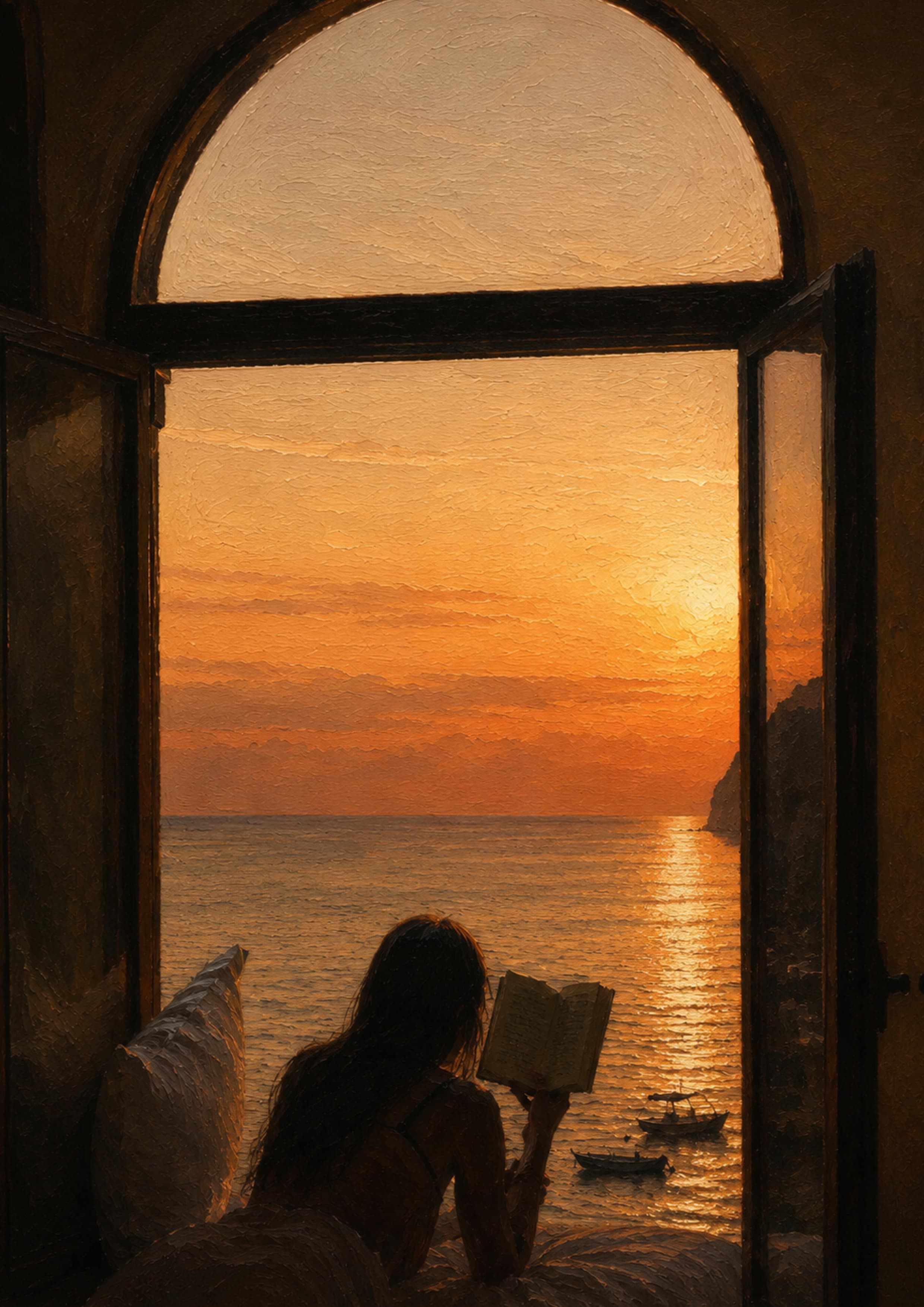
There was a time when the evening meant something.
Not just the absence of daylight. Not just the hours between work and sleep. But a genuine shift in energy. A transition. A moment in the day where you put down whatever you’d been carrying and stepped into something slower, warmer, more considered.
People dressed for the evening. They prepared for it. They treated it as a separate act from the rest of the day, with its own rituals, its own rhythm, its own rules. The evening was not the end of the day. It was the point of it.
And somewhere along the way, we lost that.
Think about what most evenings look like now.
Work bleeds into dinner. Dinner bleeds into the sofa. The sofa bleeds into the phone. The phone bleeds into sleep. There’s no boundary between one part of the day and the next. No ritual. No signal that tells your mind and your body that the working day is over and something different has begun.
The evening has become an extension of the afternoon, which was an extension of the morning. One long, undifferentiated blur of screens and tasks and half-attention, from the moment you wake up until the moment you fall asleep.
And we wonder why nothing feels special anymore.
The evening used to be an event.
Not a grand one. Not a formal one. Not something that required a reservation or a dress code. But an intentional one. You came home. You washed the day off. You changed your clothes, even if you weren’t going anywhere, because the act of changing signalled to yourself that the next few hours were different. That they mattered.
You cooked something. Not quickly, not distractedly, but with attention. You set the table even if it was just for you. You poured something to drink and you sat down and you ate without a screen in front of your face. The food tasted better because you were actually tasting it.
If you had company, the evening became a conversation. A real one. The kind that breathes. The kind where nobody is checking the time or glancing at notifications. The kind where you stay at the table long after the plates are cleared because the conversation has taken on a life of its own and leaving feels like interrupting something important.
If you were alone, the evening became a space. For reading. For thinking. For sitting with music and letting your mind move without direction. For doing nothing and letting that nothingness restore something that the day had taken from you.
Either way, the evening had weight. It had shape. It was something you inhabited, not something you endured.
There’s a reason this matters more than it seems.
Treat those hours not as the leftovers of your day, but as the reward for having lived it.
The quality of your evening dictates the quality of your rest. And the quality of your rest dictates the quality of your next day. And the quality of your days, stacked one on top of the other, dictates the quality of your life.
When your evenings are chaotic, mindless, or simply a continuation of the stress that came before them, you never actually recover. You go to bed with the same tension you woke up with. You sleep poorly. You wake up already behind. And the cycle repeats, not because life is inherently exhausting, but because you never built a boundary between the part of the day that demands something from you and the part that gives something back.
The evening is that boundary. Or at least, it should be.
Reclaiming the evening doesn’t require anything dramatic.
It doesn’t require candles and wine and jazz on vinyl, although none of those things would hurt. It requires one simple decision: that the evening is not leftovers of the day. It is its own thing. And it deserves to be treated that way.
Start with a transition. Something small that tells your brain the working hours are over. Change your clothes. Take a shower. Step outside for ten minutes. Make a drink. Whatever the ritual is, make it consistent. Make it yours. The act itself barely matters. What matters is that it draws a line.
Then protect the hours that follow. Not aggressively. Not with rigid rules. But with a quiet awareness that this time is not for productivity. It’s not for catching up on emails or scrolling through content you won’t remember tomorrow. It’s for living. For tasting your food. For being present with whoever is in front of you, even if that person is yourself.
There’s something beautiful about a person who takes their evening seriously.
You can feel it when you spend time with them. There’s no rush. No half-attention. No sense that they’re mentally somewhere else. They’ve arrived. Fully. Into the evening, into the conversation, into the moment. And being around that kind of presence is one of the rarest and most valuable experiences in modern life.
Because the truth is, most people don’t know how to be still anymore. Most people don’t know how to sit at a table without reaching for their phone. Most people don’t know how to let an evening unfold without trying to fill every second of it with stimulation.
The ones who do are magnetic. Not because they’re doing anything extraordinary. But because in a world that has forgotten how to slow down, the simple act of being fully present in your own evening is extraordinary.
The evening is not dead. It’s just been neglected.
And the beautiful thing about neglect is that it can be reversed. Tonight. Not with some elaborate plan. Not with a lifestyle overhaul. Just with a decision.
That when the sun goes down, you will stop. You will change. You will sit. You will eat something you actually enjoy. You will talk to someone or be alone with yourself. And you will treat those hours not as the leftovers of your day, but as the reward for having lived it.
That’s the art of the evening. And it’s worth learning again.
The Art of Living Beautifully.